5 Best Uninstallers for Mac: Apps Compared

Removing an app on a Mac looks deceptively simple: drag the icon to the Trash, and it is gone. What stays behind is everything the app created while it lived on your system: caches, preferences, logs, launch agents, and support folders scattered across the Library. Over time, these orphaned files pile up into gigabytes of clutter that slows down backups and eats disk space for no reason.
A dedicated uninstaller solves this by finding an app’s service files and removing them together with the app itself. There are plenty of such tools for macOS, and they differ a lot in depth, extra features, and price. Below, we compare five of the most popular options to help you pick the one that fits how you use your Mac.
If you need a quick answer
If you want the short version: App Cleaner & Uninstaller is the strongest all-round pick, because it removes an app together with its service files and also manages startup items, extensions, and updates from the same window. AppCleaner and PearCleaner cover the free end with different trade-offs, TrashMe is the sandboxed App Store option with a one-time price, and CleanMyMac makes sense only if you want a whole maintenance suite rather than an uninstaller.
| Tool | Best for | Price | Free version or trial |
|---|---|---|---|
| App Cleaner & Uninstaller | Complete uninstalls plus startup, extension, and update management | $14.95/year or $34.95 one-time | 2-day full trial |
| AppCleaner | Simple, occasional removals | Free | Free |
| PearCleaner | Advanced users and developers | Free | Free |
| TrashMe | App Store buyers who want a sandboxed tool | $17.99 one-time | 15-day trial |
| CleanMyMac | All-in-one Mac maintenance | $39.95/year or $119.95 one-time | 7-day trial, card required |
Contents
- 1. App Cleaner & Uninstaller
- 2. AppCleaner
- 3. PearCleaner
- 4. TrashMe
- 5. CleanMyMac
- Frequently Asked Questions
App Cleaner & Uninstaller
App Cleaner & Uninstaller by Nektony approaches uninstallation as part of a wider job: managing every third-party app on your Mac from one window. Applications, Startup Programs, Extensions, Remaining Files, and Updates each live in their own tab, so the app doubles as a control center for everything you have installed.
How it works
Launch the app and it scans your Applications folder, listing each program together with all of its service files. Select what you want gone and click Remove: the app, its caches, preferences, and support files leave together. Expert Mode breaks the selection down by category, so you can review exactly which executables, caches, and support folders are about to be deleted.
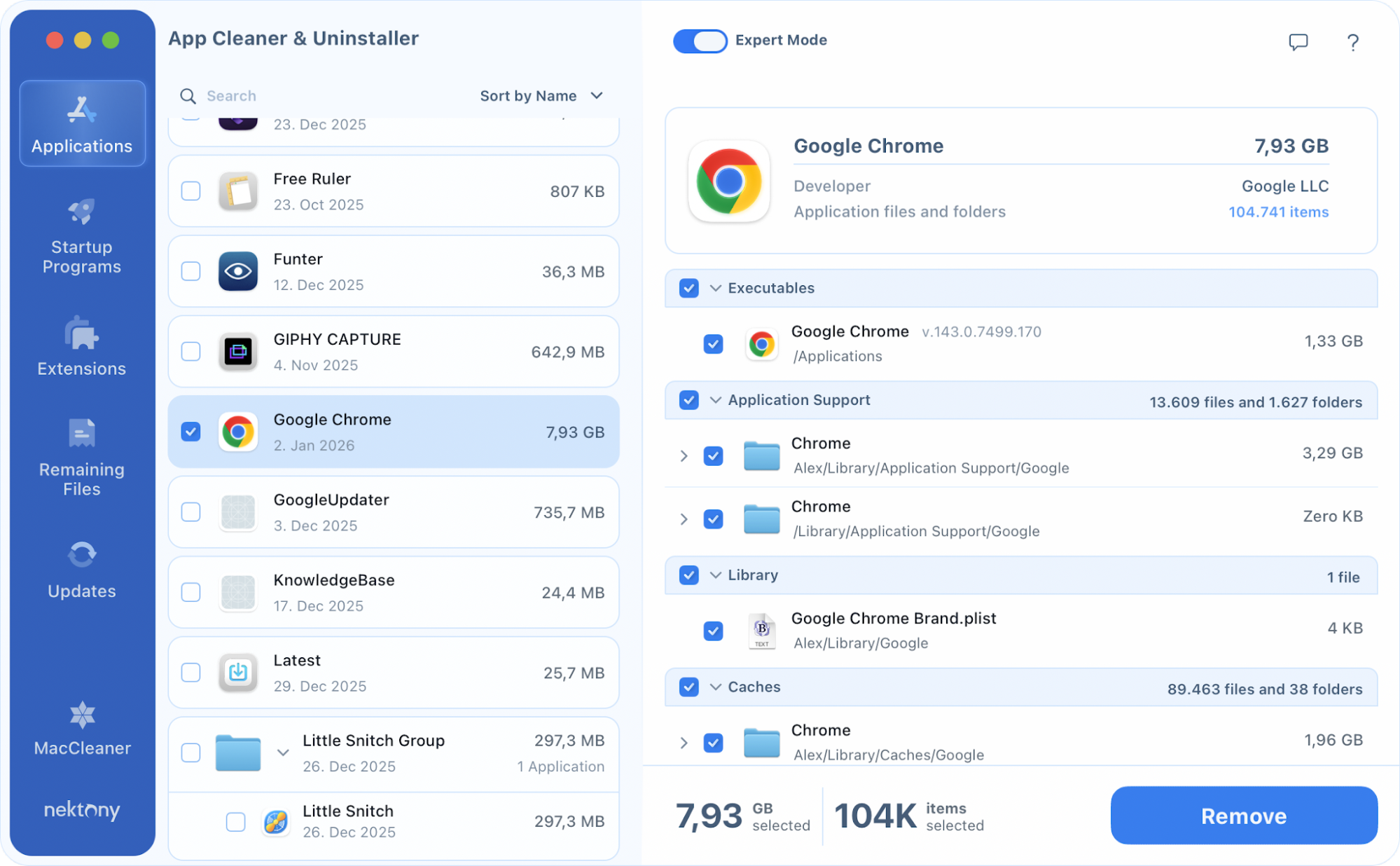
A thoughtful safety touch: when the scanner comes across an installation package, such as a leftover .dmg, it sets it aside in a separate category instead of bundling it into the deletion list. You will never wipe an installer by accident.
Extra features
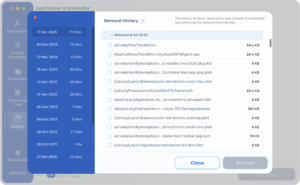
Beyond uninstalling, the app disables login items and browser extensions in a click, keeps your software up to date through the Updates tab, and records every removal in a Removal History. Anything still sitting in the Trash can be restored from that history, which turns a hasty deletion from a problem into a 2-click fix.
App Cleaner & Uninstaller is notarized by Apple, holds a 4.8 rating on Trustpilot, and runs on macOS 11.0 or newer. The license costs $14.95 per year or $34.95 one-time, with a fully featured 2-day trial: short, but enough for a complete cleanup session.
Pros
- ✓ Deep scan that catches files most tools miss
- ✓ Startup items, extensions, and updates in one window
- ✓ Removal History with file restore
Cons
- 𐄂 Trial lasts only 2 days
- 𐄂 Paid license after the trial
AppCleaner from FreeMacSoft
AppCleaner is the free veteran of this category and the definition of a single-purpose tool. There are no tabs, no maintenance modules, and almost no settings: just a small window waiting for you to drop an app into it.
How it works
Drag any application onto the AppCleaner window and it lists the related files it can find: preferences, caches, support folders. Confirm, and everything goes to the Trash. The SmartDelete option keeps watch in the background and offers a cleanup whenever you delete an app the manual way, which covers the most common real-world scenario.
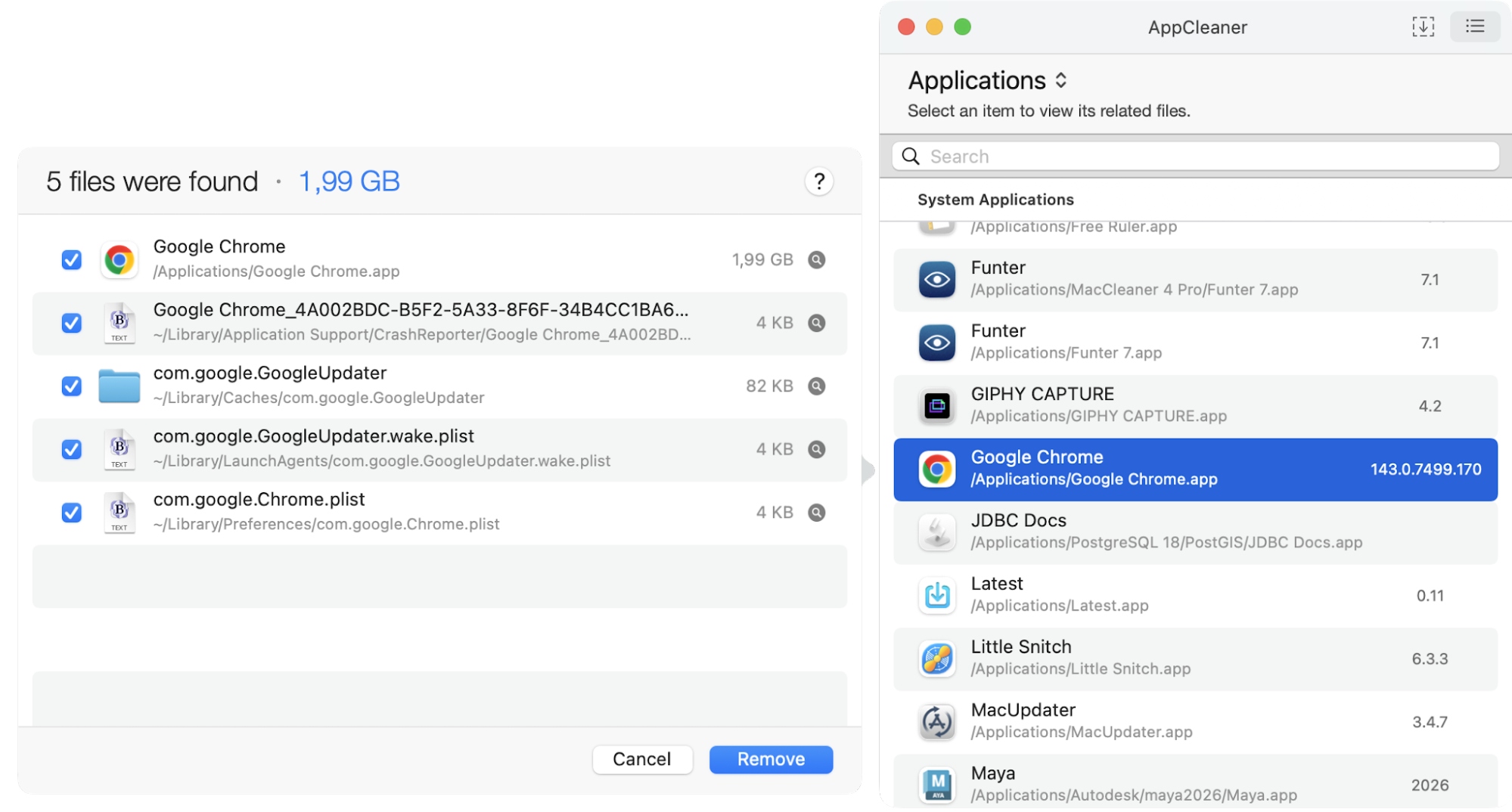
The trade-offs match the price. AppCleaner removes one app at a time, so clearing out a long list of unused programs becomes a repetitive exercise. Its scan is also noticeably shallower than what the paid tools in this list manage, and the app has been without updates since 2023, so each new macOS release raises the chance that some leftover locations go unnoticed. It supports macOS 10.14 and newer and holds a 4.9 rating on MacUpdate.
Pros
- ✓ Completely free and very light on resources
- ✓ SmartDelete catches manual deletions
- ✓ Zero learning curve
Cons
- 𐄂 Finds fewer leftovers than paid rivals
- 𐄂 No updates since 2023
- 𐄂 Removes one app at a time
PearCleaner
PearCleaner is a free, open source uninstaller built with technical users in mind. It is distributed through GitHub and bundles tooling you will otherwise only find in developer utilities.
One thing to know before you download it: the developer put the project on hold at the end of 2025, so it no longer picks up fixes for each new macOS release.
How it works
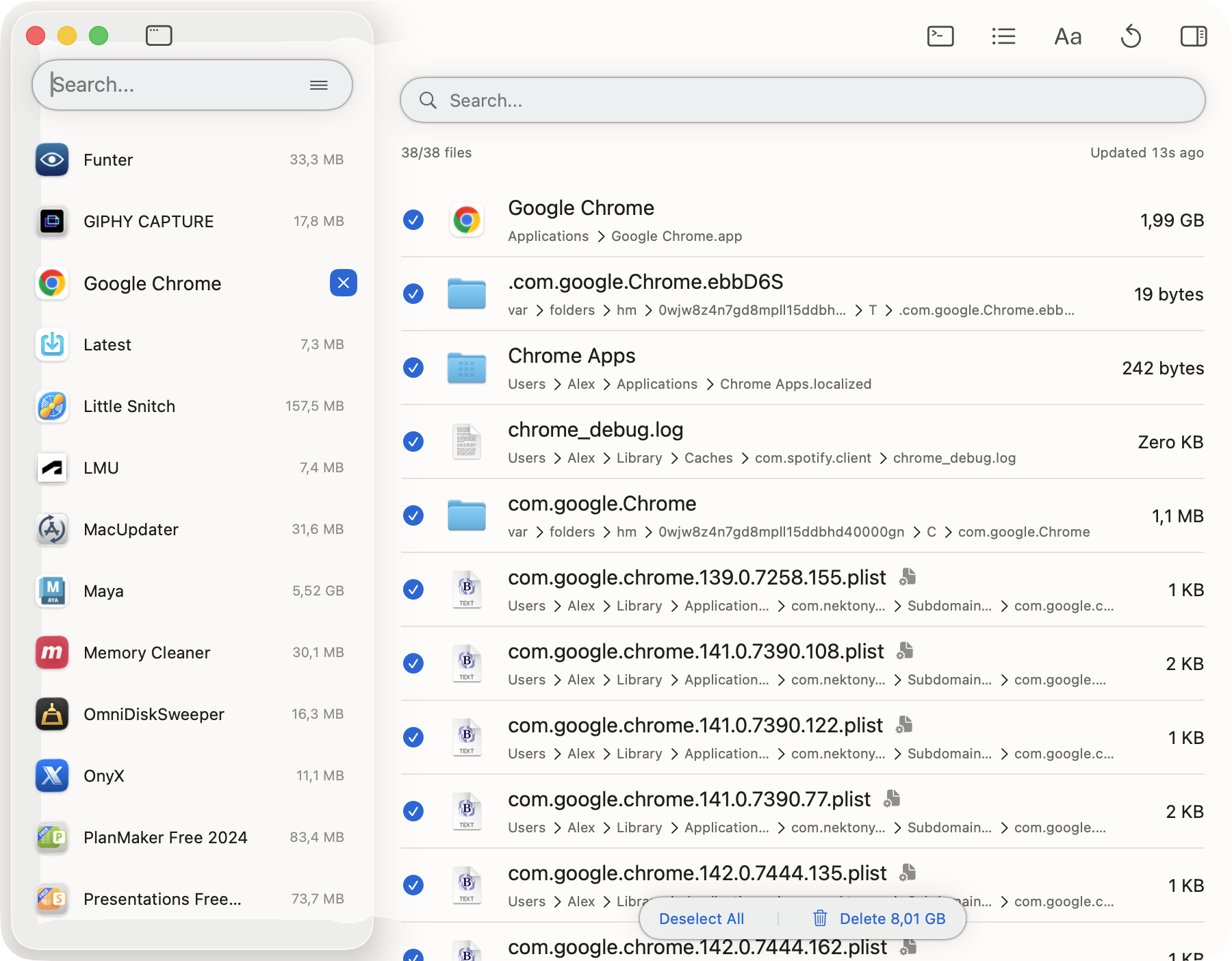
The main screen lists installed apps; pick one and PearCleaner shows every associated file it can locate, including ones in less obvious system paths.
Its scanner is arguably the most thorough of the group, and that thoroughness cuts both ways. It regularly pulls in more than the app itself: folders shared with other software from the same vendor, and files other tools deliberately leave alone. Go through the list and untick anything you do not recognize before you confirm the removal. PearCleaner shows you everything and trusts you to know what you are looking at.
Extra features
This is where the developer focus shows: Homebrew package management, launch-service controls, orphaned-file search, a built-in console, and an App Lipo feature that strips unused architectures from universal binaries to reclaim disk space. For an average user, most of these panels are noise; for a developer, they may be the reason to switch.
PearCleaner requires macOS 13.0 or newer and carries a 4.2 rating on MacUpdate. Builds have been signed and notarized with an Apple Developer account since version 3.7.7, though as with any community project, you are trusting a solo developer rather than a company. And that developer has stepped back: the repository has been marked as on hold since the end of 2025, with new releases paused indefinitely.
Pros
- ✓ Free, open source, and notarized
- ✓ Very thorough scanner
- ✓ Homebrew management and App Lipo included
Cons
- 𐄂 Development on hold since the end of 2025
- 𐄂 Aggressive scan needs manual review
- 𐄂 Interface assumes technical confidence
TrashMe
TrashMe sits between a single-purpose uninstaller and a full maintenance suite. It is one of the few tools in this category distributed through the Mac App Store, which means it runs inside Apple’s sandbox: a real argument if you are cautious about giving system access to cleaning utilities.
How it works
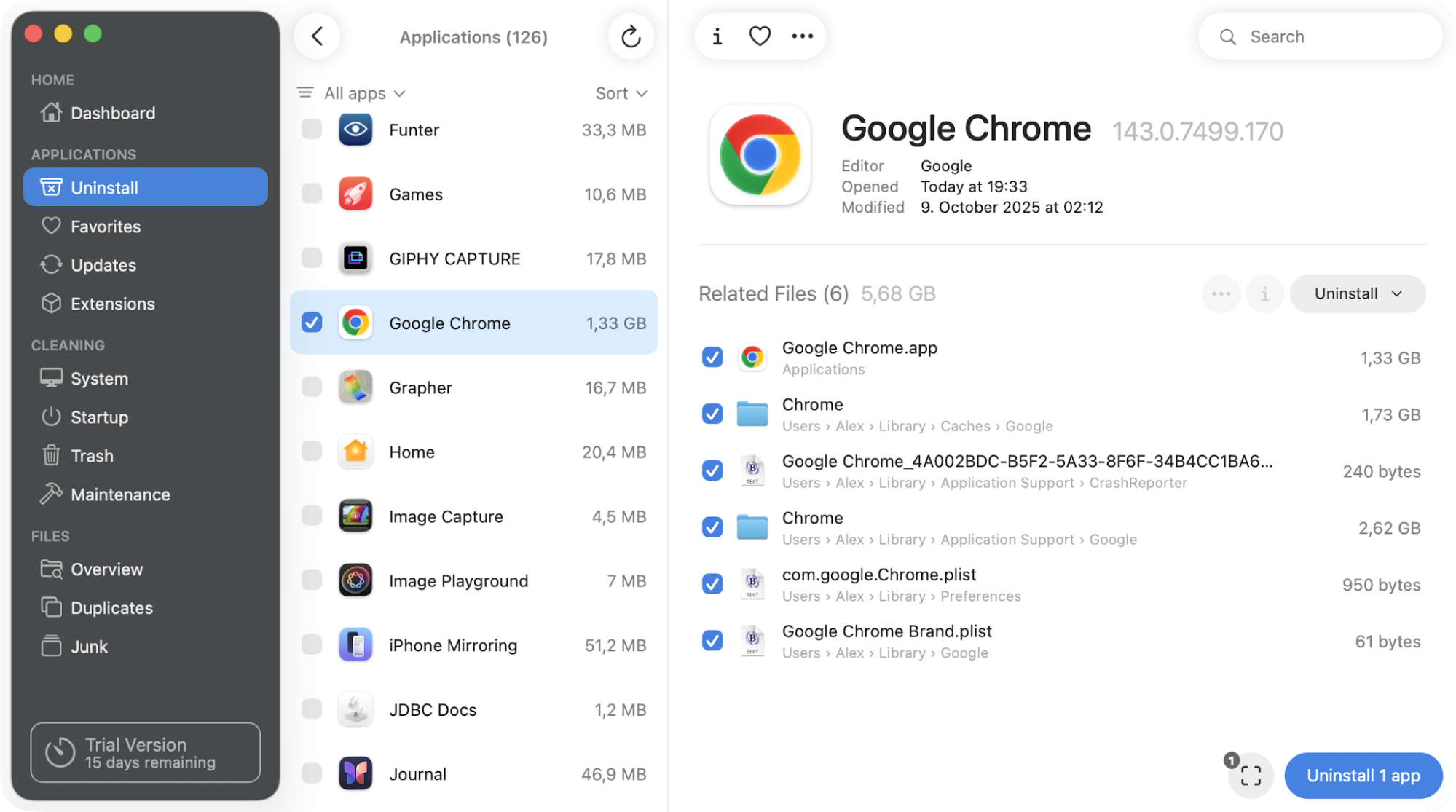
The Uninstall section lists your apps; select one and TrashMe gathers its service files for removal in a couple of clicks. The interface follows the current macOS design language closely, with clear categories and a select-then-act flow that requires no manual reading.
Extra features
Beyond uninstalling, TrashMe cleans caches, manages startup items, finds duplicate files, and gives a general overview of your disk. It also checks your installed apps for updates in the background and shows what is out of date, but it stops there: to install an update you open the app itself or its App Store page. Tools with a full update manager are still ahead on that front.
The $17.99 one-time license covers macOS 10.13 and newer, and the 15-day trial is the most generous in this lineup: long enough to run a full cleanup cycle before deciding. App Store users rate it 4.7 out of 5.
Pros
- ✓ Sandboxed and available on the App Store
- ✓ Generous 15-day trial, one-time payment
- ✓ Includes duplicate finder and cache cleaning
Cons
- 𐄂 Scanner trails the category leaders
- 𐄂 Detects app updates but does not install them
CleanMyMac
CleanMyMac is the heavyweight of the group: an all-in-one maintenance suite where the uninstaller is one module among many. If you want a single subscription to cover cleanup, security, and optimization, this is the product built around that idea.
How it works
The Applications section handles uninstalls: scan, pick the apps to remove, and CleanMyMac deletes them together with their leftovers, supporting bulk removal of several apps at once. The scan is solid and the presentation is the most polished in this comparison.
Extra features
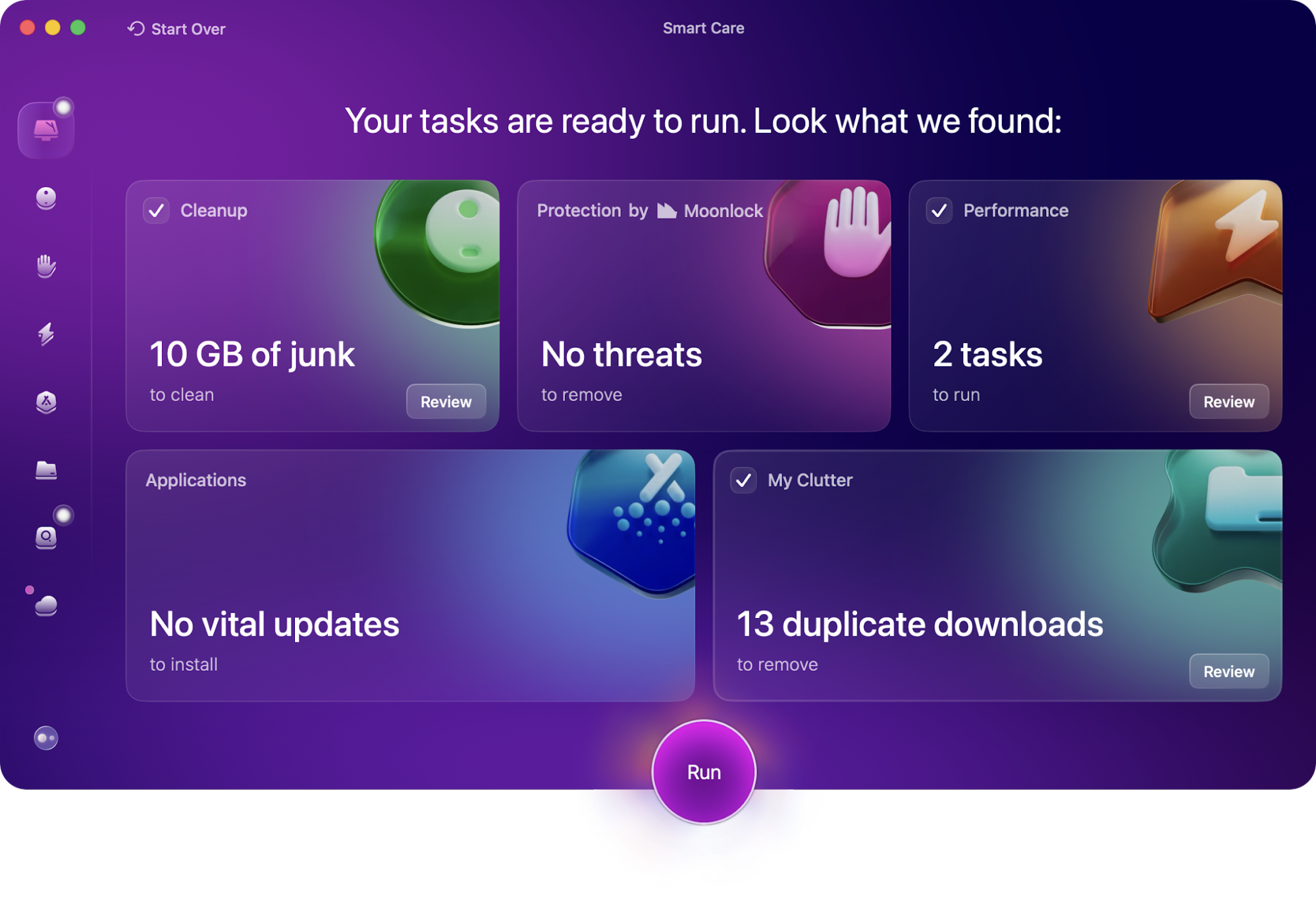
The list is long: Smart Care runs a combined system health check, Moonlock handles malware scanning, My Clutter hunts duplicate downloads, Space Lens maps disk usage, and a built-in AI assistant summarizes what each installed app does. The flip side is weight: with several modules active, CleanMyMac consumes noticeably more memory than any dedicated uninstaller, which older or 8 GB Macs will feel.
Pricing follows the suite ambitions: $39.95 per year or $119.95 one-time, for macOS 11.0 or newer. The 7-day trial asks for an email address and payment details up front, which is worth knowing before you start it. Users rate it 4.7 on Trustpilot and 4.5 on the App Store.
Pros
- ✓ Full maintenance suite with a capable uninstaller
- ✓ Polished design, AI app summaries
- ✓ Bulk uninstall of several apps at once
Cons
- 𐄂 Heavy on system resources
- 𐄂 Trial requires payment details
- 𐄂 Most expensive option here
Conclusion
Any of these five tools does a better job than dragging icons to the Trash. The right pick depends on what else you expect from the app:
- App Cleaner & Uninstaller offers the best balance for most users: a deep scanner, safeguards like Removal History and installer quarantine, plus startup, extension, and update management in one license.
- AppCleaner covers occasional one-off removals for free, as long as you accept a shallower scan and an aging codebase.
- PearCleaner appeals to developers and technical users who want full transparency and extras like Homebrew management, but development has been on hold since the end of 2025, so treat it as a tool that will slowly fall behind macOS.
- TrashMe suits App Store loyalists who value sandboxing and a friendly one-time price.
- CleanMyMac makes sense when you want a whole maintenance suite rather than a single tool, and your Mac has the resources to feed it.
Whichever you choose, check two things before committing: that the tool is notarized by Apple, and that it still receives regular updates. macOS changes every year, and an abandoned uninstaller gradually loses track of where apps hide their files.
Frequently Asked Questions
What is the best uninstaller for Mac?
App Cleaner & Uninstaller is the best choice for most people. It finds the service files that lighter tools miss, and it also handles startup programs, browser extensions, and app updates from the same window. If you only need a free tool for the occasional removal, AppCleaner does the basic job.
What is the best free Mac uninstaller?
AppCleaner is the simplest free option: drag an app onto its window, and it lists the related files. PearCleaner finds more, but its development has been on hold since the end of 2025, and its interface requires some technical confidence. Either way, free tools scan less deeply than paid ones.
Does Mac have an uninstaller?
macOS has no dedicated uninstaller. App Store apps can be deleted from Launchpad and everything else goes to the Trash, but neither method touches the caches, preferences, logs, and support folders the app left in your Library. Those stay on the disk until you remove them yourself.
Are Mac uninstallers safe?
Yes, as long as the tool is notarized by Apple and still updated regularly. Notarization means Apple has checked the app for malware. It is also worth reviewing the file list before you confirm a removal: the most aggressive scanners sometimes include folders shared with other apps from the same developer.